
March 10, 2026
Amsterdam, the Netherlands, and Las Vegas, USA – Royal Philips (NYSE: PHG, AEX: PHIA), a global leader in health technology, today highlighted how open, interoperable, AI-enabled platforms can help health systems connect continuous patient monitoring with diagnostic insights – bringing the patient story together across time and across specialties. By connecting clinical signals with diagnostic information, Philips enables care teams to move from fragmented data to a more continuous, actionable understanding of the patient.
Health systems are under unprecedented pressure, with rapidly growing data volumes stretching clinical capacity and contributing to care delays. Delays are often compounded by fragmented data across monitoring systems, imaging platforms, and clinical applications. Philips’ Future Health Index 2025 found that 77% of healthcare professionals have lost clinical time due to issues with incomplete or inaccessible patient data [1]. As providers look for ways to expand capacity without adding burden, AI is increasingly being adopted to help automate routine tasks and surface relevant insights sooner. Yet scaling AI requires trusted, interoperable, longitudinal data that can be contextualized in clinical workflows.
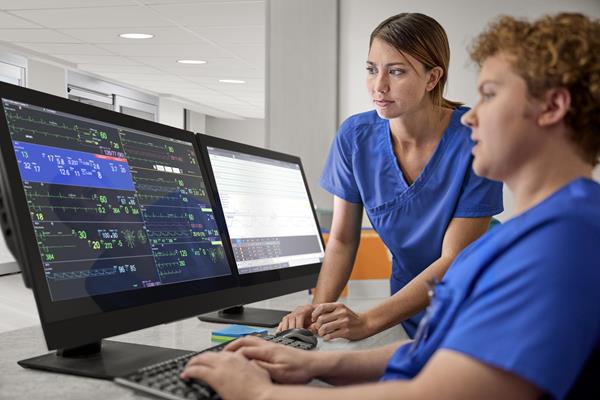
Nurses at central monitoring station
Philips’ platforms are designed to connect data, devices, and teams across care settings and diagnostic domains. By linking medical devices, patient monitoring systems, imaging platforms, and health information systems – including EMR and third-party technologies – Philips enables health systems to create a unified data foundation that supports continuous visibility and longitudinal insight across the enterprise. At HIMSS26, Philips is showcasing two core capabilities that help make this connected care intelligence possible: enterprise patient monitoring that enables longitudinal care intelligence, and Integrated Diagnostics that brings imaging and diagnostic data together across the enterprise.
“Care is longitudinal – it doesn’t begin or end at the hospital door,” said Julia Strandberg, Chief Business Leader Connected Care at Royal Philips. “When data is connected across environments, clinicians can see a more continuous patient trajectory rather than disconnected snapshots. That broader context helps reduce noise, improve situational awareness, and allow care teams to focus their time on what matters most: earlier intervention and better patient outcomes.”
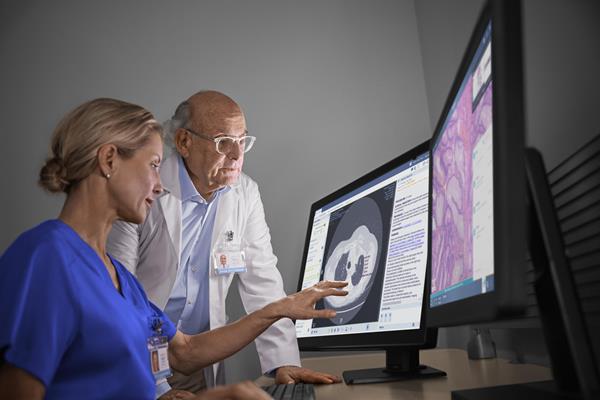
Integrated Diagnostics, radiology and pathology
Enterprise patient monitoring – enabling longitudinal care intelligence
Across the acute and post-acute continuum, clinicians need continuous visibility that travels with the patient. Philips is advancing longitudinal care intelligence by connecting enterprise monitoring with interoperable clinical data – so physiologic signals remain visible as patients move across care settings, including in high-acuity environments, during transitions of care, and after discharge.
By integrating medical devices and health information systems, including EMRs and a broad ecosystem of third-party devices, Philips helps create a connected data thread with central monitoring and surveillance workflows that support clinical decision-making across encounters and over time. This longitudinal foundation can help reduce workflow friction for care teams. Connected monitoring can also support strategies to relieve pressure on high-acuity environments by supporting safe, early discharge with oversight beyond the hospital walls.
Integrated Diagnostics – enterprise imaging integration to help reduce workload
A complete patient story also depends on diagnostics. Yet in many hospitals, diagnostic imaging data live in disconnected systems across radiology, cardiology, pathology, and other specialties. Clinicians often navigate multiple viewers, logins, and workflows to access the information needed to make decisions.
Integrated Diagnostics connects diagnostic systems, workflows, and AI applications so clinicians can access a more unified view of patient imaging and diagnostic data when decisions cannot wait. Philips’ HealthSuite Integrated Diagnostics portfolio provides a comprehensive suite of cloud-based solutions designed to connect data, integrate workflows, and embed AI across the diagnostic enterprise.
“Integrated Diagnostics isn’t about adding another tool – it’s about connecting the diagnostic enterprise, so clinicians aren’t forced to assemble the story themselves,” said Shez Partovi, Chief Innovation Officer and Chief Business Leader of Enterprise Informatics at Royal Philips. “When cardiology, radiology, pathology and other diagnostic domains come together on a connected foundation, teams gain a more unified view of the patient, time to diagnosis can drop, and intelligence can be embedded into everyday workflows in a way that truly scales.”
Philips’ platform approach is built with cybersecurity, privacy, and responsible AI practices at its core. Trust is foundational to enabling data liquidity across the enterprise, supporting longitudinal context, and scaling AI in ways that strengthen clinical decision-making while minimizing unnecessary complexity.
Experience Philips at HIMSS26
At HIMSS26, Philips is demonstrating how enterprise patient monitoring and Integrated Diagnostics can reduce fragmentation, accelerate insight, and support confident action across care environments and diagnostic workflows – while giving clinicians time back to deliver better care. For more information about solutions highlighted at HIMSS26, visit here.
[1] Philips Future Health Index 2025. Available at: philips-future-health-index-2025-report-building-trust-in-healthcare-ai-global.pdf
For further information, please contact:
Anna Hogrebe
Philips Global External Relations
Tel.: +1 416 270 6757
E-mail: anna.hogrebe@philips.com
About Royal Philips
Royal Philips (NYSE: PHG, AEX: PHIA) is a leading health technology company focused on improving people’s health and well-being through meaningful innovation. Philips’ patient- and people-centric innovation leverages advanced technology and deep clinical and consumer insights to deliver personal health solutions for consumers and professional health solutions for healthcare providers and their patients in the hospital and the home.
Headquartered in the Netherlands, the company is a leader in diagnostic imaging, ultrasound, image-guided therapy, monitoring and enterprise informatics, as well as in personal health. Philips generated 2025 sales of EUR 18 billion and employs approximately 64,800 employees with sales and services in more than 100 countries. News about Philips can be found at www.philips.com/newscenter.
Attachments
- 广州四维营销:会议会务全托管,让企业招商会 “落地即成交”
- 平安人寿联合复旦大学重磅发布《新纪元·新价值:迎接黄金发展期》寿险行业白皮书
- 2025亚洲国际音乐大赛新加坡总决赛颁奖典礼精彩纷呈
- 十一度蝉联保险业第一!BrandZ《最具价值中国品牌100强》发布:中国平安位列中国品牌第九
- 3岁女童总爱凑近皱眉看人,检查竟非近视,而是得了“老年病”——福州爱尔眼科
- 2025上海别墅装修公司有哪些?高性价比推荐:1299 元 /㎡享品质装修
- 千金药业:1.5亿智能车间圆满封顶 女性健康产业升级加速
- 林华寿独创道家古法疗法攻克三尸虫取得重大突破
- 新愿景,新启航!研华加速从IPC迈入边缘计算新时代
- PIK3CA基因检测助力乳腺癌精准治疗新篇章
- 伽澜健康助力黄河金三角区域医疗机构临床营养学科建设论坛圆满举办
- 立屯精神聚合力 政企共建助振兴—中国人寿财险广西分公司联合天等县开展主题党日活动
- 《StellarSugar》12强选手惊现韩国最大中餐厅:燕京大饭店
- 有梦有方向 青春正飞扬 “青春影像”校园歌手征集最终展示活动将在重庆举办
- 山东双嘉家庭教育走进历城一中:开展心理讲座赋能青春梦想